Archaeological Investigations in the Medieval Towns
NIKU is responsible for excavations in Norway’s eight medieval towns
Contact us
NIKU is responsible for archaeological excavations in Norway’s eight medieval towns: Bergen, Stavanger, Trondheim, Tønsberg, Skien, Oslo, Sarpsborg, and Hamar.
The medieval towns are automatically protected cultural heritage sites under the Cultural Heritage Act.
A medieval town is defined as a current town that has had urban development since the Middle Ages, and where parts of today’s buildings lie on top of remains of medieval urban structures, according to the Directorate for Cultural Heritage’s guidelines for managing medieval towns.
The cultural layers from the medieval period are often several meters thick and well preserved beneath existing buildings and road structures.
The management of the medieval towns aims to ensure the preservation of these “underground archives,” while also allowing the use of land areas and the development of town centers. A key principle in the medieval towns is in situ preservation, avoiding interventions in the ground whenever possible.
If the heritage authorities grant permission for ground interventions, cultural layers may remain after construction. These must be safeguarded and secured once the project is completed.
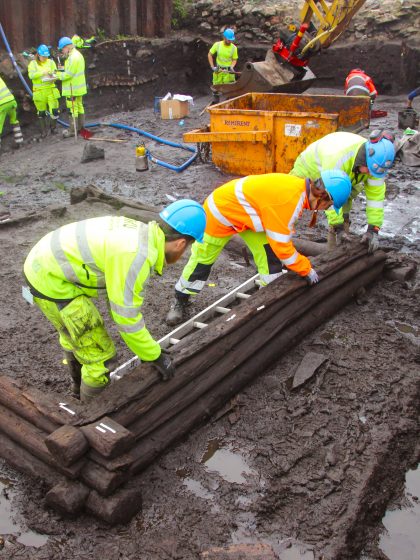
Both small and large investigations provide new and exciting knowledge about the medieval towns. Reports and documentation facilitate later research on the material. Artefacts are collected, and larger timber structures and stone cellars are documented for the future. The finds are incorporated into the museum collections.